
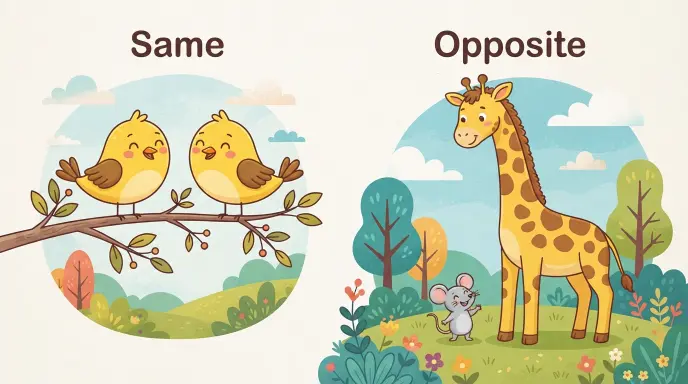
Learning new words becomes much easier for children when they can see, hear, and use them. A synonyms and antonyms video for kids can introduce children to words with similar meanings and words with opposite meanings in a fun, memorable way. Instead of memorizing long definitions, kids can learn through simple examples, pictures, repetition, and short sentences.
This guide explains how children can learn synonyms and antonyms through videos and activities. It includes easy word pairs, examples, teaching ideas, common mistakes, and simple practice exercises for parents, teachers, and young learners.
Quick Answer
A synonyms and antonyms video for kids teaches children that synonyms are words with similar meanings, while antonyms are words with opposite meanings. For example, happy and glad are synonyms, while happy and sad are antonyms. Videos make these concepts easier through pictures, sounds, repetition, and simple sentences.
Quick List of Synonyms and Antonyms for Kids
Easy Synonym Examples
- Big — Large
- Small — Little
- Happy — Glad
- Fast — Quick
- Smart — Clever
- Begin — Start
- End — Finish
- Pretty — Beautiful
- Angry — Mad
- Quiet — Silent
- Easy — Simple
- Funny — Amusing
- Gift — Present
- Help — Assist
- Jump — Hop
Easy Antonym Examples
- Big — Small
- Hot — Cold
- Happy — Sad
- Fast — Slow
- Up — Down
- In — Out
- Day — Night
- Open — Closed
- Old — New
- Easy — Difficult
- Light — Dark
- Early — Late
- Clean — Dirty
- Strong — Weak
- Near — Far
What Are Synonyms?
Simple Definition of Synonyms
Synonyms are words that have the same or similar meanings.
For example:
- Happy — Glad
- Big — Large
- Fast — Quick
- Small — Little
The words do not always mean exactly the same thing. Sometimes one word fits a particular situation better than another.
Kid-Friendly Example
Imagine a child receives a birthday present.
You could say:
“Sara is happy.”
You could also say:
“Sara is glad.”
Both sentences tell us that Sara feels good about something.
Why Kids Should Learn Synonyms
Synonyms help children:
- Build a stronger vocabulary
- Avoid repeating the same word
- Understand books more easily
- Improve creative writing
- Express ideas more clearly
- Learn different ways to describe things
What Are Antonyms?
Simple Definition of Antonyms
Antonyms are words with opposite meanings.
For example:
- Hot — Cold
- Tall — Short
- Day — Night
- Happy — Sad
- Open — Closed
Antonyms are often easy for young learners because children can understand opposite ideas through pictures and real-life examples.
Kid-Friendly Example
Think about a door.
When the door is not shut, it is open.
When the door is shut, it is closed.
So:
Open ↔ Closed
Why Kids Should Learn Antonyms
Learning opposites can help children:
- Understand word meanings
- Describe differences
- Improve reading skills
- Build vocabulary
- Follow classroom instructions
- Recognize relationships between words
Why Videos Help Kids Learn Synonyms and Antonyms
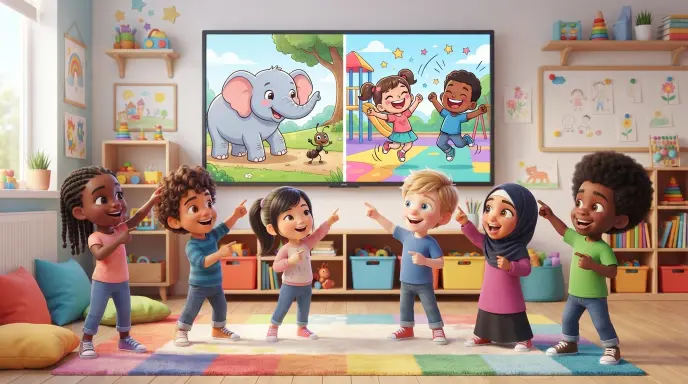
Visual Learning
Children can understand a word faster when they see a picture connected to it.
For example, a picture of a huge elephant can introduce:
Big — Large
A picture of ice and fire can demonstrate:
Cold — Hot
Audio and Pronunciation
Hearing a word helps children learn how it sounds. A good educational video can pronounce each word clearly and repeat it several times.
Repetition Makes Words Memorable
Children often remember information better when they encounter it more than once. A video can repeat important words without making the lesson feel like a traditional vocabulary exercise.
Short Examples Make Meaning Clear
Instead of only showing:
Fast = Quick
a video can show:
“The rabbit is fast.”
“The rabbit is quick.”
This helps children understand how the words work in sentences.
Synonyms for Kids With Simple Examples
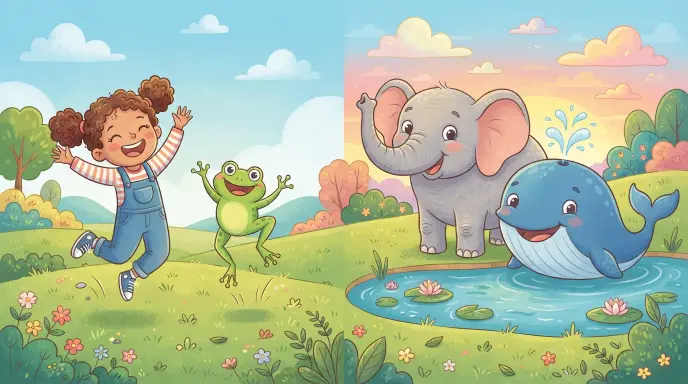
Big — Large
Meaning: Something that has a lot of size.
Example:
“The elephant is big.”
“The elephant is large.”
Best use: Everyday speaking, schoolwork, and simple descriptions.
Tone: Both are neutral.
Note: Large can sound slightly more formal than big, but children can usually understand both.
Happy — Glad
Meaning: Feeling pleased or joyful.
Example:
“I am happy today.”
“I am glad today.”
Best use: Happy is more common in everyday English.
Tone: Both are friendly and positive.
Fast — Quick
Meaning: Moving or happening at a high speed.
Example:
“The car is fast.”
“The car is quick.”
Note: These words are often related, but they are not interchangeable in every sentence. For example, we commonly say “a quick answer,” while “a fast answer” may sound different depending on context.
Smart — Clever
Meaning: Having good thinking or problem-solving ability.
Example:
“Ali is smart.”
“Ali is clever.”
Tone: Both can be positive.
Note: Clever can sometimes focus more on being good at finding solutions.
Small — Little
Meaning: Not large in size.
Example:
“She has a small dog.”
“She has a little dog.”
Note: Little can also express affection or emphasize something being tiny, so it is not always a perfect replacement for small.
Begin — Start
Meaning: To do something from the beginning.
Example:
“The class will begin at nine.”
“The class will start at nine.”
Tone: Begin can sound slightly more formal; start is extremely common in everyday English.
Pretty — Beautiful
Meaning: Attractive or pleasing to look at.
Example:
“She has a pretty dress.”
“She has a beautiful dress.”
Note: These words can differ in strength and style. Beautiful often expresses stronger praise.
Antonyms for Kids With Simple Examples
Hot — Cold
Meaning: Opposite temperature conditions.
Example:
“The soup is hot.”
“The ice is cold.”
Tone: Neutral and common.
Happy — Sad
Meaning: Opposite emotional states.
Example:
“The boy is happy.”
“The girl is sad.”
These are useful early vocabulary words because children can easily understand the contrast.
Big — Small
Meaning: Opposite sizes.
Example:
“The elephant is big.”
“The mouse is small.”
Fast — Slow
Meaning: Different speeds.
Example:
“The car is fast.”
“The turtle is slow.”
Up — Down
Meaning: Opposite directions.
Example:
“Look up.”
“Look down.”
These are especially useful for young children learning basic positional vocabulary.
Day — Night
Meaning: Opposite parts of the daily cycle.
Example:
“We play outside during the day.”
“We sleep at night.”
Open — Closed
Meaning: Not shut versus shut.
Example:
“The window is open.”
“The window is closed.”
Easy — Difficult
Meaning: Something that requires little effort versus something that requires more effort.
Example:
“The question is easy.”
“The question is difficult.”
For young children, hard can also be used as an opposite of easy in many everyday contexts.
True Synonyms vs Contextual Alternatives
Not every word that appears similar can replace another word in every sentence.
| Type | What It Means | Can It Replace the Original? |
|---|---|---|
| True synonym | Has nearly the same meaning in a particular context | Usually |
| Near synonym | Has a similar but not identical meaning | Sometimes |
| Contextual alternative | Works in certain situations | Only in suitable contexts |
| Broader expression | Covers a wider meaning | Not always |
| Narrower expression | Has a more specific meaning | Only when the specific meaning fits |
Why This Difference Matters for Kids
Children should learn that vocabulary is not simply about matching two words.
For example:
Start and begin are close alternatives.
But:
Big and huge are not exactly equal. Huge usually describes something that is very large.
Likewise, happy and excited are related feelings, but they do not mean exactly the same thing.
How a Good Synonyms and Antonyms Video Should Teach Kids
Start With Familiar Words
Young learners should first encounter words they already know.
Examples include:
- Good — Bad
- Hot — Cold
- Big — Small
- Happy — Sad
- Up — Down
Use Pictures
Pictures can show the meaning without requiring a long explanation.
A video might show:
Tall tree → Short plant
or:
Full glass → Empty glass
Say the Words Clearly
Children should hear each word slowly and clearly.
For example:
“Hot. Cold. Hot is the opposite of cold.”
Add Simple Sentences
Vocabulary becomes more useful when children see words used naturally.
Instead of teaching only:
Fast — Slow
show:
“The rabbit is fast.”
“The turtle is slow.”
Include Repetition
A video can introduce a word, show a picture, use the word in a sentence, and then review it.
That creates several chances for children to remember it.
Business and Professional Contexts
Business language is generally not the main focus of a children’s vocabulary video, but older students can benefit from seeing how synonyms change according to context.
Simple Professional Examples
Start → Begin
“The meeting will begin at 10 a.m.”
Help → Assist
“Our team will assist you with your request.”
Ask → Request
“We would like to request additional information.”
These examples are more suitable for older students learning formal English.
Academic Writing
Choosing Words for Schoolwork
Students may use synonyms to make writing more varied, but they should not replace a familiar word simply to sound advanced.
For example:
“The experiment began at noon.”
This is a natural alternative to:
“The experiment started at noon.”
Avoid Unnecessary Difficult Words
A simple word is often better if it communicates the idea clearly.
Children should learn that good writing is not about using the biggest words. It is about using the right words.
Customer Service
Polite Vocabulary
Older children learning practical English may encounter polite alternatives such as:
Help → Assist
“How may I assist you?”
Ask → Request
“You can request a replacement.”
The exact choice depends on the situation and the level of formality.
Email Communication
Simple Vocabulary Changes
Students learning English for school or future work may see differences such as:
Tell → Inform
“Please inform us if your plans change.”
Ask → Request
“I am writing to request more information.”
These are more formal than everyday expressions.
Email Examples Using Synonyms
Client Information Request
Subject: Request for Additional Information
EmailRequest for Additional Information
Request for Additional Information
Hello,
I am writing to request a few additional details about the project. Please send the updated information when convenient.
Thank you,
Alex
Here, request is more formal than simply saying ask for.
Project Update
Subject: Project Update
EmailProject Update
Project Update
Hello,
I wanted to inform you that the project schedule has been updated. The revised timeline is attached for your review.
Best,
Mia
Inform gives the message a professional tone.
Meeting Message
Subject: Meeting Start Time
EmailMeeting Start Time
Meeting Start Time
Hi everyone,
The meeting will begin at 2 p.m. Please join a few minutes early so we can get started on time.
Thanks,
Daniel
Begin works well in a professional setting.
Customer Service Response
Subject: Your Support Request
EmailYour Support Request
Your Support Request
Hello,
Thank you for contacting us. Our support team will assist you with the issue and provide an update as soon as possible.
Kind regards,
Customer Support
Assist sounds more formal than help.
Teacher-to-Student Message
Subject: Assignment Question
EmailAssignment Question
Assignment Question
Hello Emma,
Thank you for your message. You can ask me about the assignment during class tomorrow, and I will be happy to explain the instructions.
Best,
Ms. Carter
Here, ask is completely natural because the context is friendly and educational.
Mini Dialogues for Learning Vocabulary
Workplace
Person A: When will the meeting start?
Person B: It will begin at 10 o’clock.
Classroom
Person A: Is this question difficult?
Person B: No, it is easy.
Customer Service
Person A: Can you help me?
Person B: Yes. I can assist you.
Casual Conversation
Person A: Why are you happy?
Person B: I am glad because we won the game!
Vocabulary Practice
Person A: What is the opposite of hot?
Person B: Cold!
How to Replace Words in a Sentence
Example 1
Original:
The movie will start at eight.
Alternative:
The movie will begin at eight.
Why it works:
Begin and start have similar meanings here.
Example 2
Original:
The child is happy.
Alternative:
The child is glad.
Why it works:
Both describe a positive emotional state, although happy is more general.
Example 3
Original:
The elephant is big.
Alternative:
The elephant is large.
Why it works:
Both describe the elephant’s size.
Example 4
Original:
The rabbit is fast.
Alternative:
The rabbit is quick.
Why it works:
Both can describe speed in this context.
Example 5
Original:
The test is easy.
Alternative:
The test is simple.
Why it works:
Simple can describe something that is not complicated, but it does not always mean exactly the same thing as easy.
Example 6
Original:
The room is quiet.
Alternative:
The room is silent.
Why it works:
Silent is stronger. It suggests that there is little or no sound.
Example 7
Original:
Please help me with this task.
Alternative:
Please assist me with this task.
Why it works:
Assist is more formal and is better suited to professional or formal communication.
Example 8
Original:
She has a beautiful dress.
Alternative:
She has a pretty dress.
Why it works:
Both can describe an attractive dress, but beautiful may express stronger admiration.
Synonym and Antonym Comparison Table
| Phrase | Tone | Meaning / Scope | Best Use | Example |
|---|---|---|---|---|
| Big | Neutral | Large in size | Everyday English | A big dog |
| Large | Neutral/Formal | Great in size | Writing and speech | A large building |
| Happy | Neutral | Positive feeling | General use | I feel happy |
| Glad | Friendly | Pleased | Conversation | I am glad |
| Start | Neutral | Begin something | Everyday use | Start the lesson |
| Begin | Slightly formal | Enter the first stage | Writing/formal speech | Begin the lesson |
| Help | Neutral | Give assistance | Everyday use | Help your friend |
| Assist | Formal | Give assistance | Professional contexts | Assist the customer |
| Fast | Neutral | Moving quickly | Everyday description | A fast car |
| Slow | Neutral | Moving at low speed | Everyday description | A slow turtle |
| Hot | Neutral | High temperature | Everyday use | Hot soup |
| Cold | Neutral | Low temperature | Everyday use | Cold water |
| Easy | Neutral | Requiring little effort | General use | An easy task |
| Difficult | Neutral/Formal | Requiring more effort | School and writing | A difficult task |
Which Alternative Should You Choose?
For Formal Writing
Use words such as:
- Begin
- Assist
- Request
- Inform
These can sound more polished when the context calls for formal language.
For Business Communication
Prefer clear, professional words such as:
- Request
- Inform
- Assist
- Begin
Do not replace every simple word with a formal alternative. Clarity should come first.
Also For Academic Writing
Choose precise words that accurately describe the idea. Begin may fit a formal sentence, but start can still be correct.
For Legal Writing
Use established legal terminology when the exact legal meaning matters. A normal synonym may not carry the same technical meaning.
For Professional Emails
Use polite, direct wording. For example:
“I would like to request further information.”
may be more suitable than:
“I want you to send me more information.”
Also For Everyday Conversation
Simple words are usually best:
- Start
- Help
- Ask
- Big
- Happy
For Casual Messages
Natural everyday vocabulary works well. Children and beginners do not need complicated words to communicate clearly.
Grammar and Usage Guide
Synonyms Are Not Always Interchangeable
Two words can have similar meanings but behave differently in sentences.
For example:
“She made a quick decision.”
This sounds natural.
Replacing quick with fast may change the naturalness of the sentence:
“She made a fast decision.”
The second sentence can be understood, but quick decision is the more common combination.
Word Forms Matter
Children should learn different forms of a word.
For example:
- Happy — adjective
- Happiness — noun
- Happily — adverb
A synonym should match the grammatical role when replacing a word.
Prepositions Can Change
Some related words require different sentence patterns.
For example:
“Listen to the teacher.”
The preposition to is part of the normal expression.
Vocabulary should therefore be learned in complete phrases, not as isolated word lists.
Capitalization
Common nouns and adjectives are normally lowercase unless they appear at the beginning of a sentence or form part of a proper name.
Correct:
“The boy is happy.”
Not:
“The boy is Happy.”
Punctuation
When synonyms appear in a sentence, normal punctuation rules still apply.
Correct:
“The test was easy, simple, and short.”
A comma can separate items in a list.
Common Mistakes to Avoid
Treating Every Similar Word as a True Synonym
Words may have related meanings without being interchangeable.
Using Difficult Words Just to Sound Smart
Children should learn that clear writing is better than unnecessarily complicated writing.
Ignoring Context
A word that works in conversation may sound strange in academic writing.
Changing the Meaning
Replacing happy with excited changes the meaning because excitement is a particular emotional state.
Using Formal Words in Casual Situations
Saying “I request your assistance” to a close friend may sound unnatural when “Can you help me?” would be better.
Using Casual Words in Formal Writing
Very casual expressions may not fit a school report, business email, or formal assignment.
Learning Words Without Sentences
Memorizing:
“Big = large”
is useful, but children learn more when they also see:
“The large elephant walked across the field.”
Forgetting Pronunciation
Knowing the meaning is only part of vocabulary learning. Children should also learn how to say and use the word.
When Not to Use a Synonym
When the Original Word Is More Precise
If start clearly expresses the intended meaning, there may be no reason to replace it with another word.
When the Alternative Changes the Meaning
Do not replace happy with excited if the person is simply pleased.
When the Alternative Sounds Too Formal
A formal word may make a simple conversation sound unnatural.
When the Alternative Is Vague
A replacement should not make the sentence less clear.
When the Original Is the Common Choice
Simple words such as help, ask, and start are often perfectly good choices.
When Teaching Beginners
Young learners benefit from familiar vocabulary before moving to more advanced alternatives.
Advanced Tips for Teaching Kids
Tone Control
Teach children that vocabulary has different levels of formality.
For example:
Casual: Help me.
Neutral: Can you help me?
Formal: Could you assist me?
The basic idea is similar, but the tone changes.
Professional Email Etiquette
Older students can learn that polite wording matters in emails.
Instead of:
“Send me the file.”
they can write:
“Could you please send me the file?”
The second version is more polite.
Politeness
Small changes can make a request sound friendlier.
Compare:
“Give me your book.”
with:
“Could I please borrow your book?”
The second sentence is more polite.
Context Alignment
The right word depends on:
- Who is listening
- Who is reading
- Why you are communicating
- How formal the situation is
- What exact meaning you want
Precision
Teach children to ask:
“Does this word mean exactly what I want to say?”
This simple question helps prevent incorrect synonym choices.
Readability
Short, familiar words are often easier to understand.
For young readers, this sentence:
“The dog is big.”
is clearer than:
“The canine is exceptionally enormous.”
Simple vocabulary is not bad vocabulary.
How Parents and Teachers Can Use a Vocabulary Video
Pause and Repeat
Pause after each word and ask the child to repeat it.
Ask for the Opposite
If the video teaches:
“Hot”
ask:
“What is the opposite?”
The child can answer:
“Cold.”
Ask for a Synonym
If the child knows happy, ask:
“Can you think of another word for happy?”
Possible answer:
“Glad.”
Use Objects Around the Room
Point to real objects.
For example:
- Open door
- Closed door
- Big book
- Small book
- Clean table
- Dirty shoes
Real objects make abstract vocabulary easier to understand.
Create a Matching Game
Write words on cards and ask children to match:
Big → Large
Happy → Glad
Hot → Cold
Up → Down
This turns vocabulary learning into an activity.
Related Questions About Synonyms and Antonyms Videos for Kids
What is another way to teach synonyms to kids?
Use pictures, simple sentences, word-matching games, and short educational videos. Start with familiar pairs such as big/large and happy/glad, then introduce less common vocabulary.
What is a simple way to teach antonyms?
Teach opposite ideas in pairs. Examples include hot/cold, up/down, fast/slow, and open/closed. Pictures and physical actions can make the contrast easier to remember.
Are synonyms exactly the same as similar words?
Not always. Some synonyms are very close in meaning, while others differ in tone, strength, or context. For example, big and huge are related, but huge usually describes something exceptionally large.
Is “start” a synonym for “begin”?
In many sentences, yes. Both can mean to begin something. However, begin can sound slightly more formal, while start is extremely common in everyday English.
Is “happy” a synonym for “excited”?
Not exactly. Both describe positive feelings, but excited usually suggests strong enthusiasm or anticipation. A person can be happy without being excited.
Why are pictures useful when teaching vocabulary?
Pictures connect a word with a visible idea. This can make abstract vocabulary easier for children to understand and remember, especially when the word is introduced with pronunciation and a simple sentence.
Should kids memorize long synonym lists?
Long lists are usually less useful than learning a smaller number of words in context. Children can learn a word more effectively when they understand its meaning, hear it, see it, and use it in a sentence.
FAQs
What are synonyms for kids?
Synonyms are words that have the same or similar meanings. Examples include big/large, happy/glad, and start/begin.
What are antonyms for kids?
Antonyms are words with opposite meanings. Examples include hot/cold, big/small, and happy/sad.
What is the easiest synonym pair for children?
Pairs such as big/large, happy/glad, and small/little are useful starting points because children often encounter these words in everyday English.
What is the easiest antonym pair for children?
Hot/cold, up/down, big/small, and happy/sad are simple opposite pairs that children can understand through everyday examples.
How can a video make vocabulary learning easier?
A video can combine spoken words, pictures, repetition, movement, and sentences. This gives children several ways to connect a new word with its meaning.
Should children learn synonyms before antonyms?
They can learn both. Antonyms may feel easier at first because opposites are often visually clear, while synonyms help children develop a richer vocabulary.
How many new words should a child learn at one time?
There is no single number that works for every child. A small group of words with plenty of practice is generally more useful than a very long list with little review.
Key Takeaways
- Synonyms have the same or similar meanings, while antonyms express opposite meanings.
- Pictures, pronunciation, repetition, and simple sentences can make vocabulary easier for kids to learn.
- Similar words are not always interchangeable, so children should learn words in context.
- Simple vocabulary is often better than a complicated word when the goal is clear communication.
- A good synonyms and antonyms lesson should focus on meaning, usage, tone, and real examples.
Conclusion
A synonyms and antonyms video for kids can turn vocabulary practice into an engaging learning experience. Children can learn that synonyms offer similar ways to express an idea, while antonyms connect words through contrast. Simple pairs such as big/large, happy/glad, hot/cold, and up/down provide an easy starting point.
The most useful approach is not to make children memorize huge word lists. Instead, introduce a few words at a time with pictures, clear pronunciation, repetition, and short sentences. As children become more confident, they can explore near synonyms and learn how tone and context affect word choice. Parents and teachers can also use matching games, conversations, and sentence exercises to reinforce each lesson. The goal is to help children understand not only what a word means, but also when and how to use it naturally.